When Was the Church of Jesus Christ of Latter day Saints Restored Again Upon the Earth
In Latter-day Saint belief, the restoration refers to a return of the accurate priesthood power, spiritual gifts, ordinances, living prophets and revelation of the archaic Church of Christ after a long catamenia of apostasy.[1] [2] [3] While in some contexts the term may likewise refer to the early history of Mormonism, in other contexts the term is used in a way to include the fourth dimension that has elapsed from the church'southward earliest beginnings until the nowadays twenty-four hours. Specially in The Church of Jesus Christ of Latter-mean solar day Saints (LDS Church building) "the restoration" is ofttimes used also as a term to encompass the corpus of religious messages from its general leaders down to the present.[4]
The restoration is associated with a number of events that occurred which are understood to take been necessary to re-establish the early on Christian church establish in the New Testament, and to gear up the earth for the Second Coming of Jesus.[five] In item, Latter Day Saints believe that angels appeared to Joseph Smith and others and bestowed various priesthood authorities on them.
Betrayment [edit]
According to the Church, the Bang-up Betrayment in Christianity began not long after the ascension of Jesus Christ.[half-dozen] Information technology was marked with the corruption of Christian doctrine by Greek and other philosophies,[7] with followers dividing into dissimilar ideological groups,[8] and the martyrdom of the apostles[9] which led to a loss of priesthood dominance to administer the church and its ordinances.[10]
With all priesthood authorities either martyred, taken from the earth, or teaching impure doctrines, in that location was a break in churchly succession, and what remained was a mere fragment of the church established by Jesus.[6] The Christian believers who survived the persecutions took it upon themselves to speak for God, interpret, amend or add to his doctrines and ordinances, and carry out his piece of work without proper authority and divine direction from God. During this fourth dimension, important doctrines and rites were lost or corrupted. Latter-day Saints specifically reject the early ecumenical councils for what they encounter equally misguided homo attempts to decide matters of doctrine without divine assistance, substituting debate and politics for divine revelation.
Latter-day Saints have said that various Old Testament and New Testament scriptures, including teachings of Christ himself, prophesy of this "falling away" or "apostasy."[xi] [12] [13] Thus, Latter-mean solar day Saints refer to the "restitution of all things" mentioned in Acts 3:20–21 and merits that a restoration of all the original and master doctrines and rites of Christianity was necessary.[14] Adherents believe that of import historical events such as the Protestant Reformation and the establishment of the United States Constitution, which explicitly allows for freedom of religion in its First Amendment, were necessary antecedents to the restoration.
Scholars today view the Latter Day Saint motility every bit emerging from the spiritual fervor of the restorationism movements spawned by the Second Great Awakening.[15] [16] [17] [18] [19] [xx] [21]
Restoration of the Gospel [edit]
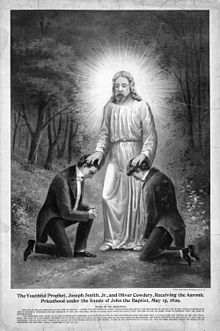
Joseph Smith, founder of the Latter Twenty-four hours Saint motion who was responsible for organizing the Church of Jesus Christ of Latter-mean solar day Saints, originally prayed about which church to join. In a vision in 1820 most Palmyra, New York, 2 personages (generally believed to exist God the Father and Jesus Christ) instructed him not to join whatever churches, for "all their creeds were an abomination." Smith described another vision in 1823 as existence visited in his bedroom by an "angel Moroni", who told him of a record of an aboriginal people written in an ancient linguistic communication on gold plates. After repeated visits by this angel in successive years, Smith described receiving and translating this ancient record and publishing the translation every bit the Book of Mormon. The Book of Mormon provided many teachings about the atonement of Christ that were not as clear in the Bible, as likewise teachings almost the House of Israel and the baptismal covenant. When Smith prayed in May 1829 about the need for baptism, he and Oliver Cowdery were visited by the resurrected John the Baptist, who past the laying on of hands gave them priesthood say-so to cognominate.
Coinciding with the restoration of the priesthood, Mormons believe that Smith received many revelations, visions, and visitations of heavenly messengers to instruct him in gild to enable him to fulfill his responsibilities in propounding doctrine and re-establishing ordinances and temple covenants. These instructions came to Smith often in response to specific questions he asked in prayer. The bulk of this history is recorded in one of the standard works, the Doctrine and Covenants. Boosted details and background of the church building in Smith's era is presented in the Church's seven volume History of the Church.
In regard to the restoration of priesthood potency, Smith dictated the following passage found in Doctrine and Covenants 128:20–21:
And again, what do we hear?...The vocalism of Peter, James, and John in the wilderness between Harmony, Susquehanna county, and Colesville, Broome county, on the Susquehanna river, declaring themselves as possessing the keys of the kingdom, and of the impunity of the fulness of times! And once more, the vocalism of God in the sleeping room of one-time Begetter Whitmer, in Fayette, Seneca county, and at sundry times, and in defined places through all the travels and tribulations of this Church of Jesus Christ of Latter-mean solar day Saints! And the phonation of Michael, the archangel; the voice of Gabriel, and of Raphael, and of defined angels, from Michael or Adam down to the nowadays fourth dimension, all declaring their impunity, their rights, their keys, their honors, their majesty and celebrity, and the power of their priesthood; giving line upon line, axiom upon precept; here a niggling, and there a little; giving u.s. alleviation by belongings forth that which is to come, confirming our hope!
In reflecting upon the responsibilities of instruction the constant revelations he received, Smith stated:[22] [23]
It is my meditation all the day, and more than than my meat and drinkable, to know how I shall make the Saints of God comprehend the visions that roll like an overflowing surge before my listen.
Personages who appeared to Joseph Smith [edit]
As part of the process of the restoration, Joseph Smith stated that a number of personages appeared to him to deliver messages, priesthood authority, or other education from God. These personages appeared either every bit resurrected beings or equally translated beings. According to H. Donl Peterson, the post-obit 50 personages appeared to Smith:[24] [25]
| # | Personage | References |
|---|---|---|
| 1 | God the Father | JS–H 1:17; HC ane:v; D&C 76:20 |
| 2 | Jesus Christ | JS–H i:17; HC 1:5–half-dozen; D&C 76:20–24, 110:ii–ten |
| three | Moroni | JS–H 1:30–49; JD 17:374 |
| four | Elijah | D&C 110:13–16; JD 23:48 |
| five | John the Baptist | D&C 13; HC ane:39–40 |
| six–8 | Peter, James, John | D&C 128:20; HC ane:40–42; JD 18:326 |
| 9 | Adam (Michael) | HC 3:388; D&C 107:53–57, 128:21; HC 2:380; JD 9:41, 18:326, 21:94, 23:48 |
| 10 | Noah (Gabriel) | D&C 128:21; JD 21:94, 23:48 |
| xi | Raphael | D&C 128:21 |
| 12 | Moses | D&C 110:eleven; JD 21:65, 23:48 |
| 13 | Elias | D&C 110:12; JD 23:48 |
| 14 | Abraham | JD 21:94, 23:48 |
| xv | Isaac | JD 21:94 |
| 16 | Jacob | JD 21:94 |
| 17 | Enoch | JD 21:65, 94; HC 3:388; D&C 107:53–57 |
| 18–26 | The Twelve Jewish Apostles (Peter, James, and John counted to a higher place) | JD 21:94 |
| 27–38 | The Twelve Nephite Disciples (including the Three Nephites) | JD 21:94 |
| 39 | Nephi | JD 21:161 |
| forty | Seth | JD 21:94; HC iii:388; D&C 107:53–57 |
| 41 | Methuselah | JD 18:325; HC 3:388; D&C 107:53–57 |
| 42 | Enos | JD 18:325; HC 3:388; D&C 107:53–57 |
| 43 | Mahalaleel | JD eighteen:325; HC 3:388; D&C 107:53–57 |
| 44 | Jared | HC 3:388; D&C 107:53–57 |
| 45 | Lamech | JD 18:325 |
| 46 | Abel | JD 18:325; HC three:388 |
| 47 | Cainan | HC 3:388; D&C 107:53–57 |
| 48 | Zelph the Lamanite | TS 6:788 |
| 49 | Alvin Smith | HC 2:380 |
| fifty | Mormon | JD 17:374 |
Significance and impact of the Restoration [edit]
According to the Church of Jesus Christ of Latter-twenty-four hour period Saints, all priesthood keys necessary to administrate Jesus' church building were given to Joseph Smith, who re-organized that church, which will go on in perpetuity. Hence, members refer to their church every bit "The Church of Jesus Christ." The term "Latter-mean solar day Saints" refers to the fact that members of early Christianity were originally called "saints", and the church reestablished by Smith is believed to be Christ's church in the final days prior to the second coming of Jesus. Members of the church do not utilize the term to point they are meliorate than others in any way, but rather that they are striving to follow Jesus Christ in their personal daily walks of life.[26]
Members of the Church believe that the restored church of Jesus Christ is the "only truthful and living church upon the face of the Globe" considering of the divine dominance restored through Joseph Smith. They believe that the Church is the restoration of Jesus' original church, has the authentic priesthood authority, and all doctrines and ordinances of the gospel, fulfilling many of the prophecies of Daniel, Isaiah, Ezekiel, and Malachi in the One-time Attestation and also the prophesies of Peter, Jesus, and John the Revelator in the New Testament.
Members of the Church building of Jesus Christ of Latter-twenty-four hour period Saints maintain that other religions have a portion of the truth, mingled with inaccuracies. They also maintain that many other religions advance many good causes and practise much practiced among the people insofar as they are led by the light of Christ, "which lighteth every man that cometh into the world" (John 1:ix). The Church of Jesus Christ maintains an international humanitarian program and strives to "do adept unto all men" (Galatians 6:ten). The Book of Mormon: Another Testament of Jesus Christ, which true-blue members of the Church believe is 1 of the keystones of their faith, and are encouraged to read it along with the Bible, teaches that "all men are alike unto God" and that "When ye are in the service of your swain beings ye are just in the service of your God (Mosiah 2:17)".
Missionaries of the Church challenge all people everywhere to read the book for themselves, and pray to God to know if it is truthful. They believe that the validity of the Book of Mormon is interconnected with the validity of the Church building: if the Book of Mormon is truthful, then the Church is true, and all people everywhere should seek this noesis for themselves (Moroni 10:3-5). Members of the Church believe that afterwards one gains a knowledge of the truthfulness of the book of Mormon, one should exist baptized a member of the Church to follow the example that Jesus Christ has sent.
See besides [edit]
- Mormonism and Christianity
- The Restoration of the Fulness of the Gospel of Jesus Christ
References [edit]
- ^ Brown, Matthew B. (2000). All Things Restored: Evidences and Witnesses of the Restoration. American Fork, Utah: Covenant Communications. ISBN978-1577347125.
- ^ Bickmore, Barry R. (2013) [1999]. Restoring the Ancient Church: Joseph Smith and Early Christianity. Redding, California: FairMormon. ISBN978-1893036161.
- ^ Shipps, Jan (1988). Hughes, Richard T. (ed.). "The Reality of the Restoration and the Restoration Ideal in the Mormon Tradition". The American Quest for the Archaic Church. Urbana: University of Illinois Press. pp. 181–195. ISBN978-0252060298.
- ^ Mormon messages by L. Tom Perry, where he uses the term in this way.
- ^ Russell, Thomas A. (2010). Comparative Christianity: A Student'due south Guide to a Religion and Its Various Traditions. Irvine, CA: Universal Publishers: 'Mormon Restorationism is the largest ethnic religious motion found in Northward America. Among its fellow member churches are the approximately 100 or so groups that trace their roots,' Chapter Sixteen: 'Joseph Smith, Jr. and Mormon Restorationism,' p. 151.
- ^ a b Missionary Department of the LDS Church building (2004). Preach My Gospel (PDF). LDS Church building, Inc. p. 35. ISBN0-402-36617-4. Archived from the original (PDF) on 2010-06-02.
- ^ Talmage, James Eastward. (1909). The Great Betrayment. The Deseret News. pp. 64–65. ISBN0-87579-843-8.
- ^ Richards, LeGrand (1976). A Marvelous Piece of work and a Wonder. Deseret Volume Company. p. 24. ISBN0-87747-161-4.
- ^ Talmage, James Due east. (1909). The Great Apostasy. The Deseret News. p. 68. ISBN0-87579-843-8.
- ^ Eyring, Henry B. (May 2008), "The True and Living Church", Ensign, LDS Church building: xx–24
- ^ Galatians i:6-viii
- ^ 2 Thessalonians two:3
- ^ Isaiah ii:2,3; 5:xiii,24,26; ten:xx-22; 11:11,12; 24:5; 27:6; 28:11; 29:four,x-fourteen; 35:10; 49:6-26; 51:11, 54; 60:2
- ^ Faust, James East. (May 2006), "The Restoration of All Things", Liahona, LDS Church building: 61–62, 67–68
- ^ Bushman, Richard L. (1984). Joseph Smith and the Beginnings of Mormonism. Urbana: University of Illinois Press.
- ^ Cross, Whitney R. (1950). The Burned-Over District: The Social and Intellectual History of Enthusiastic Religion in Western New York, 1800–1850. Ithaca, NY: Cornell University Press.
- ^ Hatch, Nathan O. (1989). The Democratization of American Christianity. New Haven, CT: Yale University Printing.
- ^ Hill, Marvin Due south. (1989). Quest for Refuge: The Mormon Flight from American Pluralism. Salt Lake Metropolis: Signature Books.
- ^ Noll, Mark A (2002). America's God: From Jonathan Edwards to Abraham Lincoln. Oxford, UK: Oxford University Press.
- ^ Shipps, Jan (1985). Mormonism: the Story of a New Religious Tradition. Urbana: University of Illinois Printing.
- ^ Vogel, Dan (1989). Religious Seekers and the Advent of Mormonism. Salt Lake City: Signature Books.
- ^ "Joseph Smith's Prophetic Mission". New Era. Dec 2009. p. 37. Retrieved 30 November 2021.
- ^ "Volume D-i [1 August 1842–1 July 1843]". The Joseph Smith Papers, History, 1838–1856. p. 1534. Retrieved xxx November 2021.
- ^ H. Donl Peterson, Moroni: Ancient Prophet, Mod Messenger, pp. 139–41
- ^ Barker, Margaret (2004). An Extraordinary Gathering of Angels. London: MQ Publications Ltd., pp. 402-403, 412-413.
- ^ Melt, Quentin L. (November 2003), "Are You lot a Saint?", Liahona, Intellectual Reserve, Inc: 95–96
Further reading [edit]
- Barker, Margaret (1987; Revised Ed, 2005). The Older Testament: The Survival of Themes from the Ancient Majestic Cult in Sectarian Judaism and Early Christianity. London: SPCK; Sheffield Phoenix Press.
- Barker, Margaret (1991; Revised Ed, 2008). The Gate of Sky: The History and Symbolism of the Temple in Jerusalem. London: SPCK; Sheffield Phoenix Press.
- Barker, Margaret (1992). The Great Angel: A Report of State of israel'south 2d God. London: SPCK; Louisville, KY: Westminster/John Knox Printing.
- Barker, Margaret (2003). The Slap-up High Priest: The Temple Roots of Christian Liturgy. London & New York: T&T Clark/Continuum.
- Barker, Margaret (2004). Temple Theology: An Introduction. London: SPCK.
- Barker, Margaret (2005). 'Joseph Smith and Preexilic Israelite Organized religion.' Provo, UT: BYU Studies 44:4 (December 2005).
- Barker, Margaret (2007). The Hidden Tradition of the Kingdom of God. London: SPCK.
- Barker, Margaret (2008). Temple Themes in Christian Worship. London: T&T Clark.
- Barker, Margaret & Gary Northward. Anderson, et al (2012). Mormonism and the Temple: Examining an Ancient Religious Tradition. Academy for Temple Studies Conference, 29 Oct 2012. Logan, UT: Utah Land Academy.
- Barker, James L. (1951, Three volumes; Revised Ed, 1984). Apostasy from the Divine Church. Salt Lake Urban center: Deseret News Press; Bookcraft.
- Barkun, Michael. (1986). Crucible of the Millennium: The Burned-over District of New York in the 1840s. Syracuse: Syracuse University Press.
- Barlow, Philip 50. (1991). Mormons and the Bible: The Place of the Latter-day Saints in American Organized religion. New York: Oxford University Press.
- Bickmore, Barry R. (1999; Revised Ed, 2013). Restoring the Ancient Church: Joseph Smith and Early Christianity. Redding, CA: FairMormon.
- Brown, Matthew B. (2009). A Colonnade of Light: The History and Message of the Outset Vision. American Fork, UT: Covenant Communications.
- Dark-brown, Matthew B. (2000). All Things Restored: Evidences and Witnesses of the Restoration. American Fork, UT: Covenant Communications.
- Brown, Matthew B. (1999). The Gate of Heaven: Insights on the Doctrines and Symbols of the Temple. American Fork, UT: Covenant Communications.
- Chocolate-brown, Matthew B. (1997). Symbols in Stone: Symbolism on the Early Temples of the Restoration. American Fork, UT: Covenant Communications.
- Bushman, Richard 50. (2005). Joseph Smith: Rough Stone Rolling. New York: Knopf.
- Butler, Jon. (1990). Awash in a Sea of Faith: Christianizing the American People. Cambridge, MA: Harvard University Press.
- Callister, Tad R. (2006). The Inevitable Apostasy and the Promised Restoration. Salt Lake Urban center: Deseret Volume.
- Christensen, Kevin. (2013). 'Prophets and Kings in Lehi'southward Jerusalem and Margaret Barker's Temple Theology.' Provo, UT: Interpreter: A Journal of Mormon Scripture 4:177-193.
- Hansen, Klaus J. (1981). Mormonism and American Culture. Chicago: University of Chicago Press.
- Harper, Steven C. & Andrew H. Hedges, eds. (2004). Prelude to the Restoration: From Apostasy to the Restored Church building. 2004 Sidney B. Sperry Symposium. Provo, UT: Religious Studies Middle, Brigham Immature University & Deseret Volume.
- Hatch, Nathan O. (1989). The Democratization of American Christianity. New Haven: Yale Academy Press.
- Hatch, Nathan O. & Noll, Mark A. (1982). The Bible in America: Essays in Cultural History. New York: Oxford Academy Press.
- Huchel, Frederick M. (2009). 'Antecedents of the Restoration in the Ancient Temple: Margaret Barker's Temple Themes in Christian Worship.' Provo, UT: FARMS Review 21:1.
- Hughes, Richard T., ed. (1988). The American Quest for the Primitive Church. Urbana: Academy of Illinois Press.
- Jackson, Kent P. (1996). From Betrayment to Restoration. Salt Lake City: Deseret Book.
- Jackson, Kent P., ed. (2011). The King James Bible and the Restoration. Provo, UT: Religious Studies Centre, Brigham Young Academy & Deseret Volume.
- MacKay, Michael H. (2016). Sacred Space: Exploring the Birthplace of Mormonism. Provo, UT: Religious Studies Eye, Brigham Young University & Deseret Book.
- Marsh, W. Jeffrey, ed. (2005). Joseph Smith and the Doctrinal Restoration. Provo, UT: Religious Studies Centre, Brigham Young University & Deseret Book.
- Millet, Robert 50. (2016). Precept upon Precept: Joseph Smith and the Restoration of Doctrine. Salt Lake City: Deseret Book.
- Morrison, Alexander B. (2005). Turning from Truth: A New Await at the Cracking Apostasy. Salt Lake City: Deseret Book.
- Nibley, Hugh W. (2001). When the Lights Went Out: 3 Studies on the Ancient Apostasy. Provo, UT: Neal A. Maxwell Found for Religious Scholarship, Brigham Immature University & Deseret Book.
- Nibley, Hugh W. (1954; 1987). The World and the Prophets (The Collected Works of Hugh Nibley, Volume three). Provo, UT: Foundation for Ancient Research and Mormon Studies (FARMS) & Neal A. Maxwell Institute for Religious Scholarship, Brigham Young Academy & Deseret Book.
- Nibley, Hugh W. (1987). Mormonism and Early Christianity (The Nerveless Works of Hugh Nibley, Book iv). Provo, UT: Foundation for Ancient Inquiry and Mormon Studies (FARMS) & Neal A. Maxwell Institute for Religious Scholarship, Brigham Immature Academy & Deseret Volume.
- Nibley, Hugh Westward. (2004). Apostles and Bishops in Early Christianity (The Collected Works of Hugh Nibley, Book fifteen). Provo, UT: Foundation for Ancient Enquiry and Mormon Studies (FARMS) & Neal A. Maxwell Institute for Religious Scholarship, Brigham Young University & Deseret Volume.
- Noll, Mark A. & Luke E. Harlow, eds. (1990; Second Ed, 2007). Faith and American Politics: From the Colonial Period to the Present. Oxford, UK: Oxford Academy Press.
- Noll, Mark A. (1992). A History of Christianity in the United States. Grand Rapids, MI: William B. Eerdmans Publishing Company.
- Ostler, Craig J., ed. (2016). Foundations of the Restoration: Fulfillment of the Covenant Purposes. 2016 Sidney B. Sperry Symposium. Provo, UT: Religious Studies Center, Brigham Young University & Deseret Book.
- Petersen, Scott R. (2005). Where Have all the Prophets Gone? Revelation and Rebellion in the Old Testament and the Christian World. Springville, UT: Cedar Fort, Inc.
- Reynolds, Noel B., eds. (2005). Early on Christians in Disarray: Contemporary LDS Perspectives on the Dandy Apostasy. Provo, UT: Foundation for Ancient Research and Mormon Studies (FARMS) & Brigham Young University Printing.
- Roberts, B. H. (1893). Outlines of Ecclesiastical History. Salt Lake City: George Q. Cannon & Sons.
- Sandeen, Ernest R. (2008) [1970]. The Roots of Fundamentalism: British and American Millenarianism, 1800-1930. Chicago: University of Chicago Press.
- Talmage, James East. (1909). The Great Apostasy: Considered in the Light of Scriptural and Secular History. Salt Lake City: Deseret News.
- Underwood, Grant (1999) [1993]. The Millenarian World of Early Mormonism. Urbana: Academy of Illinois Printing.
- Welch, John W., ed. (2006). The Worlds of Joseph Smith: A Bicentennial Briefing at the Library of Congress. Provo, UT: BYU Studies & Brigham Immature University Press.
External links [edit]
- "The Restoration of the Truth" at Mormon.org - Official LDS Church website explaining Mormon belief
Source: https://en.wikipedia.org/wiki/Restoration_(Mormonism)
0 Response to "When Was the Church of Jesus Christ of Latter day Saints Restored Again Upon the Earth"
Post a Comment